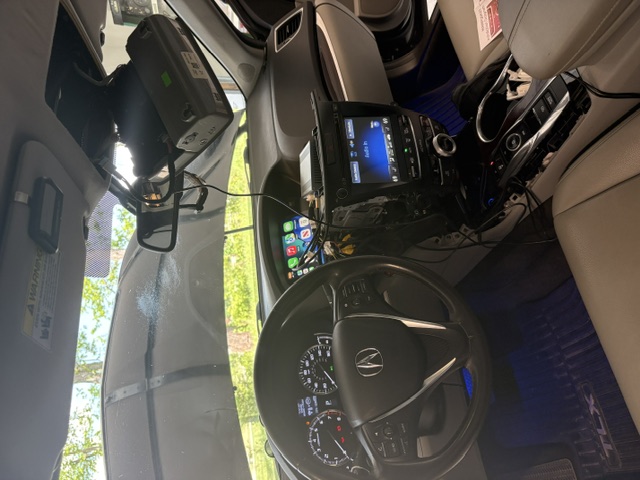
“Just take it to the shop.”
That’s what it looks like from the driver’s seat. The infotainment screen freezes or you’re trying to install an aftermarket Carplay module, you hand over the keys, you come back to a screen that works. To the person who owns the data, building the AI tool is one action too. You hand over the data, you come back to working software. Both are illusions, and they’re the same illusion.
The complaint that comes in is never the actual fault. “The screen freezes.” But a frozen screen could be a corrupted software build, a failing head unit, a flaky connector on the CAN bus, or a module that just needs reflashing. Swap the whole unit when all it needed was a software update and the customer paid for a part that fixed a problem they didn’t have. So before you touch anything, you have to find out what’s actually broken. Nothing about the frozen screen tells you that from the outside.
Then you have to reach the unit. That means pulling the climate controls, the trim, the whole center stack, easing out brittle plastic clips that crack if you rush them. And the whole time you have to know what not to do. Yank a connector with the battery live and you can fry an adjacent module. Interrupt a software flash halfway and you brick the unit entirely. It goes dark and silent, and now you’ve turned one problem into a worse one. None of that caution is visible to anyone. It just looks like a person carefully not making things worse.
Once the part is in or the software is flashed, you’re still not done. A new head unit doesn’t know it’s in this car yet. You have to code it to the VIN, recalibrate the backup camera, pair it back onto the vehicle’s network so the steering-wheel buttons and the climate display actually talk to it. The screen lighting up is not the same as the system working. So you test it the way it’ll really be used. Bluetooth pairing, camera in reverse, audio through every speaker. Not just “does it power on.” Only then do you hand back the keys.
Every one of those steps has a twin on the software side.
The frozen screen that isn’t the real fault is the request that isn’t the real requirement. “Just summarize our tickets” when the tickets are duplicated, malformed, and what they actually need is routing. Before any model runs you’re parsing the documents, figuring out what’s signal and what’s noise, deciding whether this is a retrieval problem, a fine-tuning problem, or just a careful prompt against a frontier model. Pick wrong here and you’ve spent six weeks building the wrong thing very well.
The center stack you dismantle to reach the unit is everything you build before the model does anything useful. The document parsing pipeline for the PDFs and scans nobody mentioned in the kickoff. The OCR pass on the handwritten pages. The chunking strategy, the embedding store, the vector database, the retrieval logic. The API calls between services. The auth, the queues, the caching, the logging that lets you debug it three weeks later when something quietly drifts. The evaluation harness with a real test set, not three hand-picked examples that looked good in a demo. Every one of those steps is invisible to the person who said “just give the AI the data,” and skip any of them and there’s nothing for the model to actually be smart about.
The interrupted flash that bricks the module is the plausible, confident, hallucinated output you accept without reading. Code that imports libraries that don’t exist. API calls to endpoints renamed two versions ago. A function signature the model invented because it was statistically likely. It compiles, it demos, it ships, and then it fails silently in production the first time a real user does anything the demo didn’t cover.
Coding the new unit to the VIN is the part everyone forgets. Which model is actually right for this job, not the one with the loudest launch post. Sonnet or Haiku or Opus, GPT or Gemini or an open model running locally on your own hardware. Cost per call, latency budget, context window, tool-use reliability, refusal behavior. You only know by running the same task across all of them on inputs that look like the real thing and scoring the outputs against a rubric you wrote, not against vibes. Then prompt iteration, regression tests so the next prompt change doesn’t quietly break what already worked, the deploy pipeline that has to ship the model and the code and the eval set together, monitoring once it’s live, drift detection when the upstream model gets quietly updated under you. Output is not the same thing as working software, the same way a screen that turns on is not the same thing as an infotainment system you can actually drive with.
So when someone says “just take it to the shop” or “just give the AI the data,” they’re saying the same sentence. They’re describing the two seconds that don’t matter and skipping the countles hours that do. The entire craft of the work is the part that’s invisible from the driver’s seat. And being invisible is exactly what makes people think it was nothing.